

Executive Summary
Although Gen Z and younger generations are considered “AI Natives”, our recent surveys indicate that they are the least excited and most concerned about the impacts of generative AI in the workplace. Gen Z candidates (between the ages of 18 to 29) are less interested in working with GenAI, are more concerned about the impact of GenAI, and expect AI to be less important for their next job relative to all other ages combined. More Gen Z candidates are worried than excited about the GenAI across all other job families besides STEM or Business and Finance. However, we failed to find any age effects on AI adoption or the frequency of daily use at work. In our Q2 Talent Insight Report, we explore age differences in workplace AI attitudes, expectations, adoption, and behavior from 142,476 job candidates.
Younger generations are typically assumed to be the quickest to adopt and embrace new technologies as research firms like Pew and NORC have reported that Gen Z uses AI more than all other adults and is more likely to use AI at work. Despite these findings, however, Gen Z appears to be increasingly skeptical of the benefits of generative AI. Most notably, several graduation ceremonies featured grads booing speakers for advocating AI during their speeches. Our findings are aligned with these recent accounts and are contrary to common assumptions about age and technology use. Although younger people may be the first to adopt and embrace new technologies, Gen Z candidates are not more willing to adopt workplace AI and may even be more skeptical about its impact.
Organizations should avoid generalizations about age and technology or assuming that younger employees will be more receptive to AI. Since they are more likely to be early adopters, many Gen Z candidates have already tried using AI and have their own personal experiences with these tools. This is why we see greater Gen Z use in STEM jobs or to help write resumes and cover letters, prepare for interviews, or learn about companies during their job search. For other tasks or jobs, however, Gen Z candidates may have had more negative experiences where they were pushed to adopt AI without a clear linkage to job success. This explains why we see the strongest skepticism among those seeking jobs where AI does not cleanly fit into existing work processes like providing care or service to other people or doing hands-on work.
A Note From the Author
Gen Z’s embrace of AI stops at the edge of STEM.
Young people are usually expected to be the first to dive in and experiment with new technologies. That holds true for clients hiring STEM roles, where Gen Z candidates are already the strongest adopters of AI for work and the most excited about its impact. For every other job, Gen Z is the most skeptical age group in our data.
Most candidates, Gen Z included, are not using AI for work, and Gen Z candidates are more skeptical about its importance and more worried about its impact than any other age group. Notably, their skepticism does not show up in their behavior: Gen Z uses AI at work at nearly identical rates to everyone else. I see generative AI failing to meet the hype in much of the job market.
For all of the threats made about AI disrupting workplaces and industries, many of which AI executives are now walking back, the generation that was supposed to be most open to AI does not consider it a vital workplace tool. Only 31% of Gen Z candidates expect AI to be important in their next job. Right now, their optimism is reserved for a narrow set of highly technical, STEM-based roles.

Matt Brown
Senior Research Scientist
What does Gen Z think about using AI at work?
Gen z candidates (Ages 18-29) are less interested in using generative AI and consider it less important for their next job.
Across multiple surveys, Gen Z candidates expressed less favorable attitudes towards generative AI at work compared to older candidates. The figures indicate a significant age gap in attitudes towards AI that is consistent for both male and female candidates and across nearly all job families, excluding STEM jobs. Below, we report how Gen Z view generative AI at work relative to all others and explore how these trends persist when separating candidates based on current AI adoption, job families, and candidate gender.
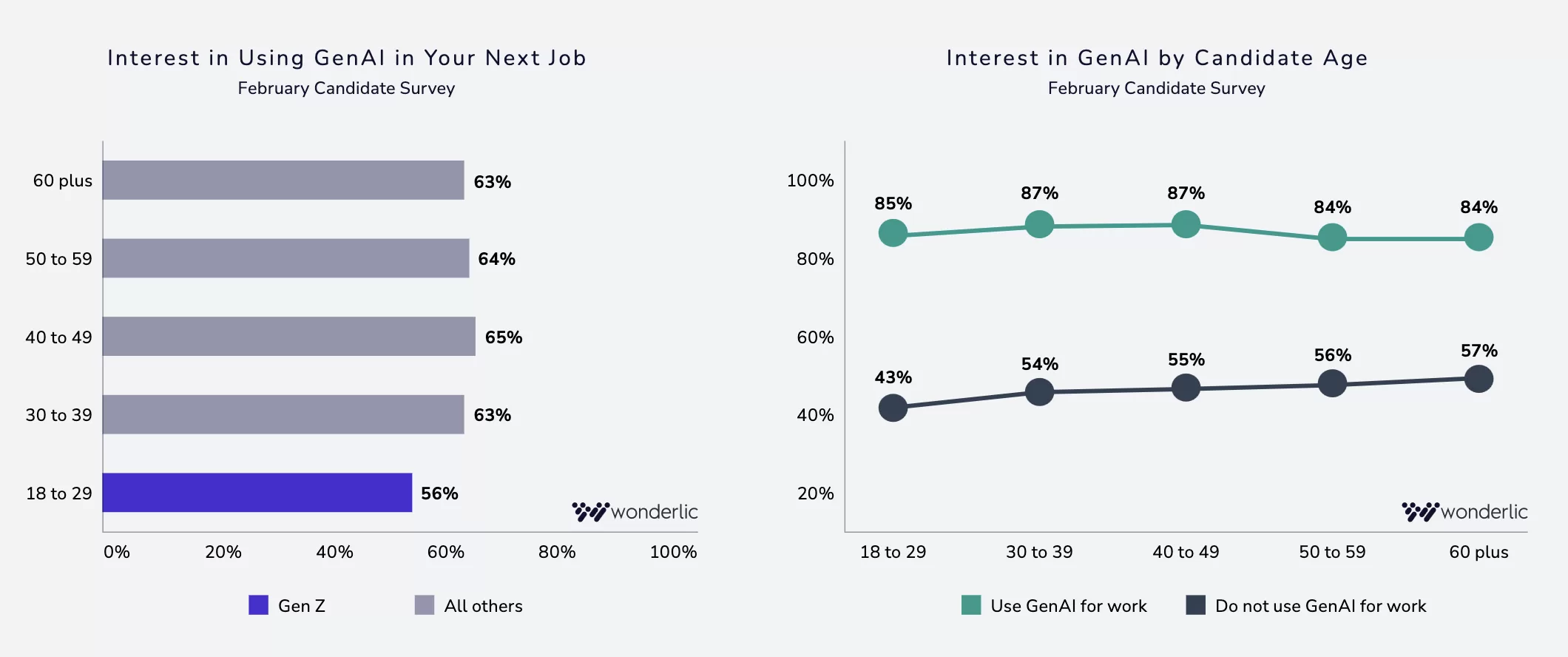
Younger candidates express less interest in using GenAI in their next job (56%) compared to all other candidates (64%). Despite little difference among candidates over the age of 30 (all between 63-65%), interest among Gen Z candidates (ages 18-29) was 9 percentage points lower. In our prior Q1 talent report, we identified that the expected importance of GenAI was driven by current AI adoption. Therefore, we estimated the effect of candidate age on AI importance and interest based on present AI use. Among candidates who are not using AI for work, AI interest was 12 percentage points lower for younger candidates (43%) compared to all others (55%) but we did not find any age differences among candidates who already use GenAI at work.
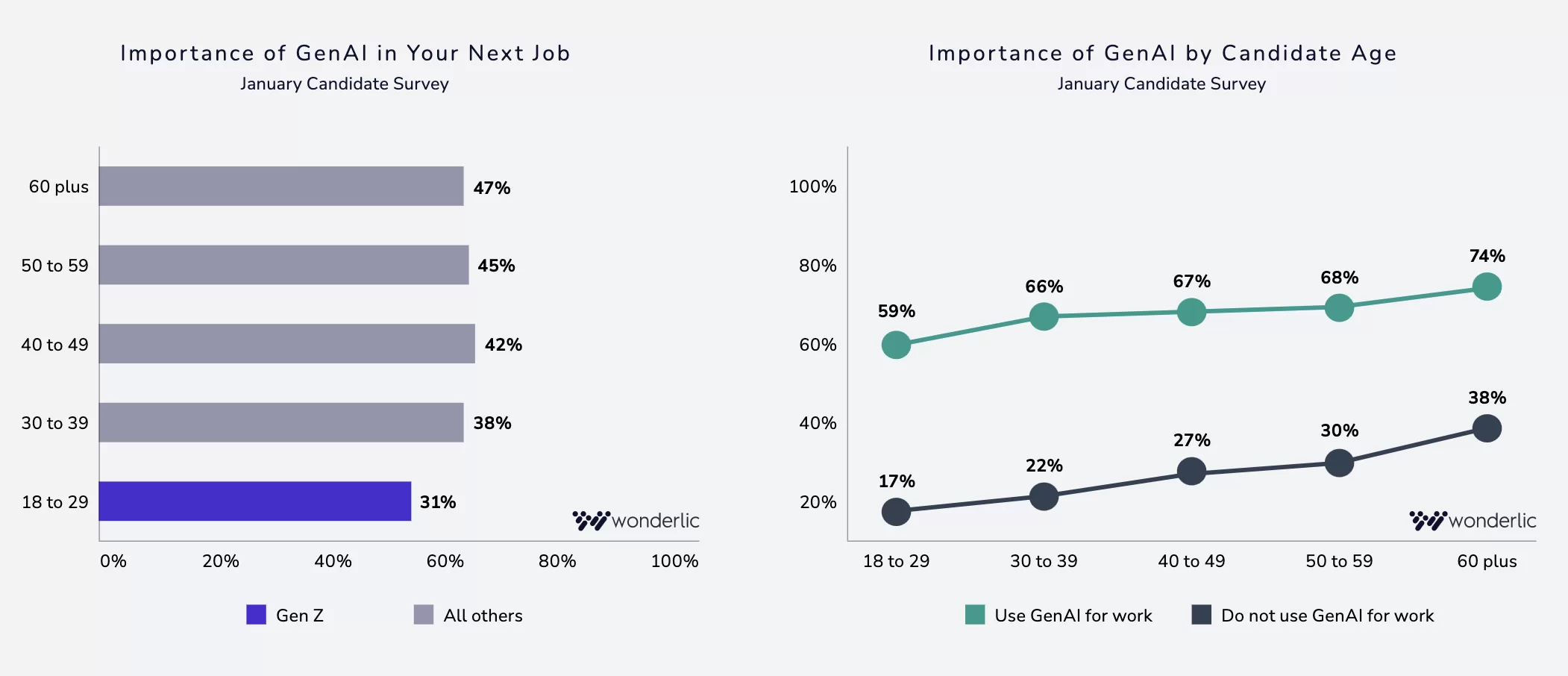
We next examined results from our prior survey of 45,000 candidates from January and found that Gen Z candidates were less likely to expect GenAI to be important in their next job (18-29 yr olds = 31% vs. 41% all other ages). When asked whether GenAI will be important in their next job, fewer Gen Z candidates consider GenAI important regardless of their current use of AI at work.
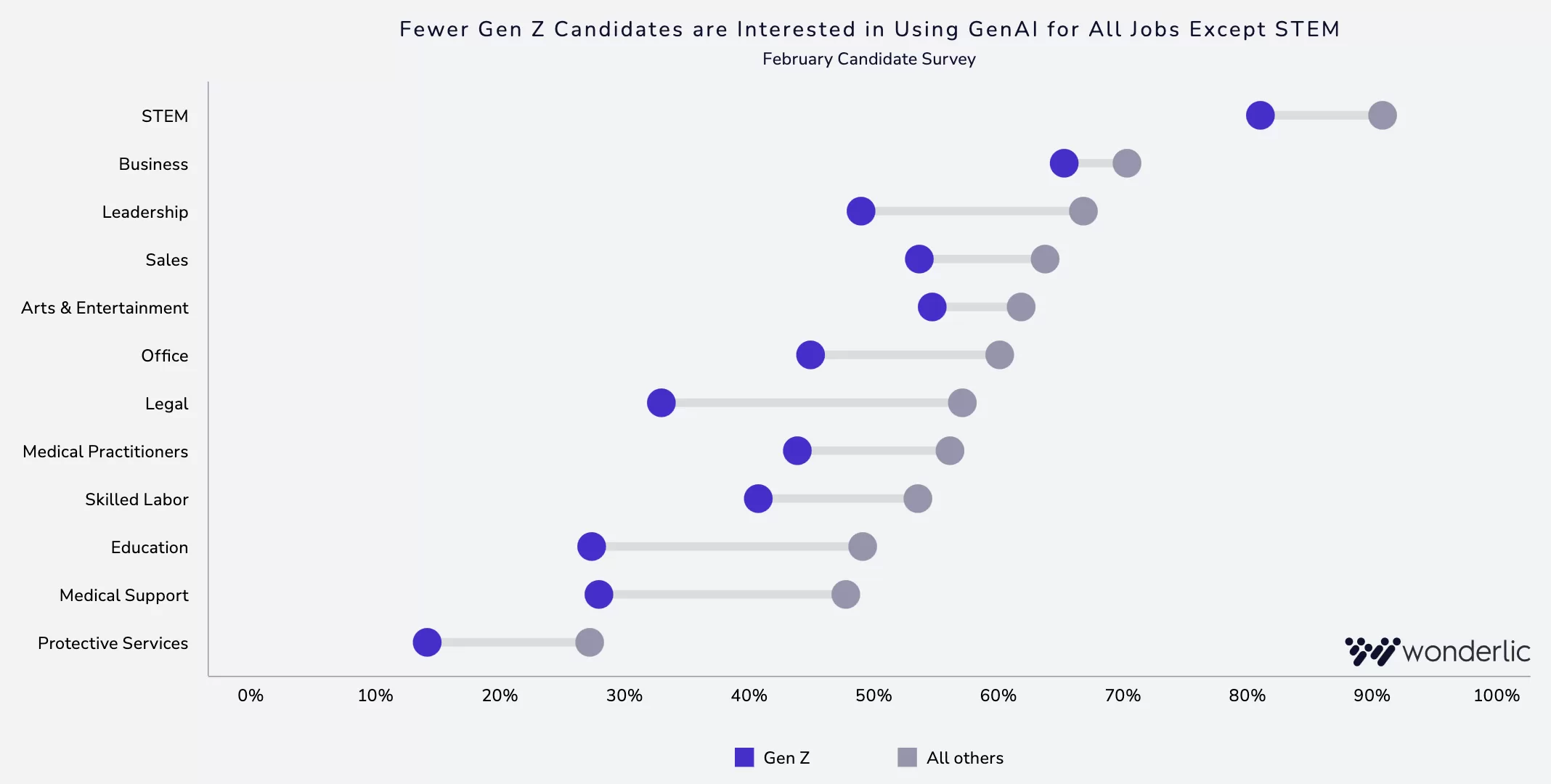
We observed that the interest gap between Gen Z and all other candidates was generally consistent across job families. The sole outlier was STEM jobs where Gen Z candidates were more interested in working with GenAI compared to all other candidates (+10). In contrast, Gen Z candidates were substantially less interested in working with GenAI for Legal (-24), Education (-22), Medical Support (-20), Leadership (-18), and Office jobs (-15). We observed the smallest interest gaps for Business/Finance (-5) and Arts and Entertainment jobs (-7).
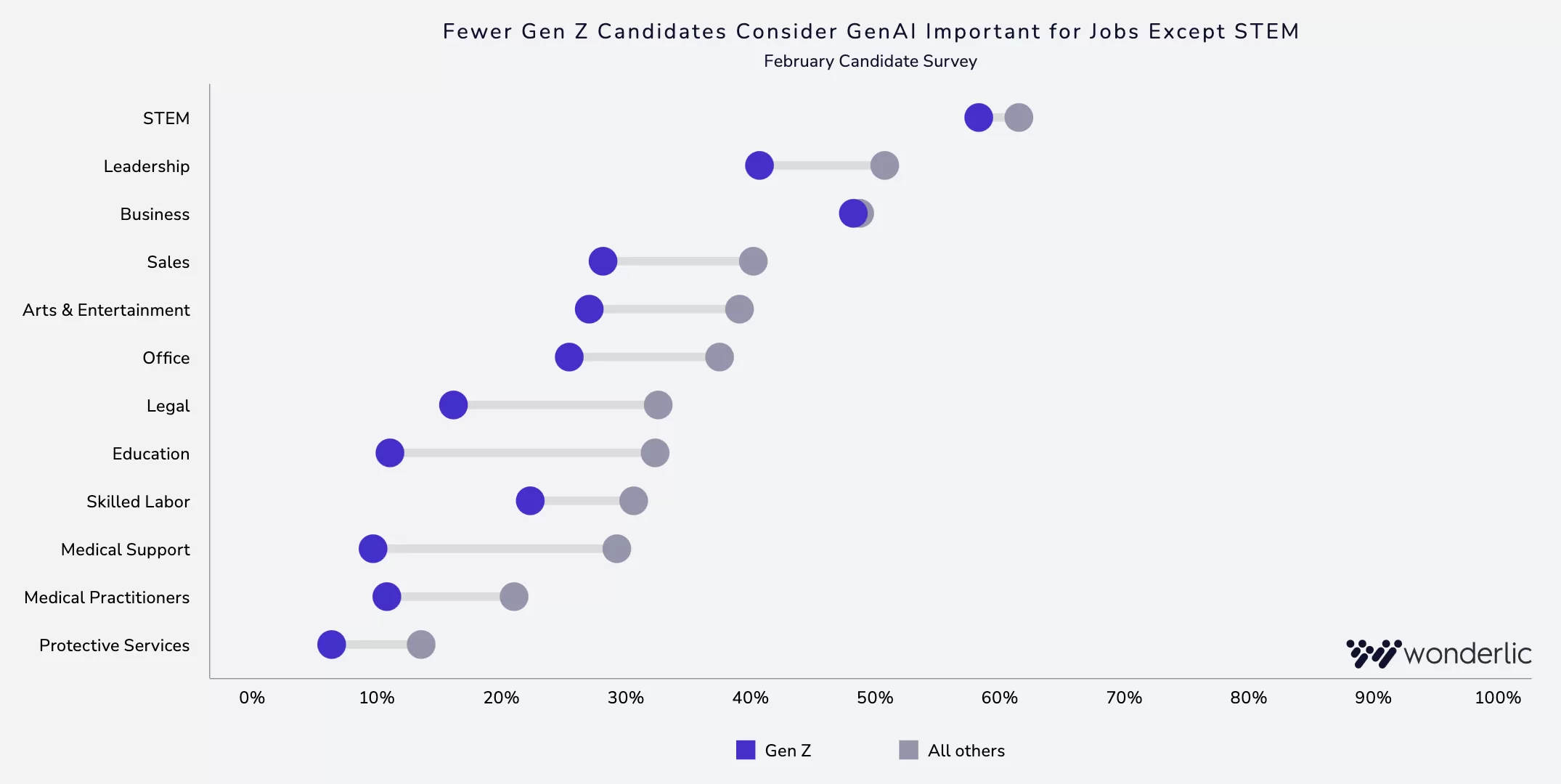
Likewise, fewer Gen Z candidates expect generative AI to be important for most jobs relative to older candidates. There was little difference in importance between age groups among candidates for jobs where AI adoption is already high: Business and Finance (both age groups = 48%) or STEM jobs (only -3 for Gen Z compared to all other candidates). We observed the largest age gaps in AI importance for Education (-22), Medical Support (-20), Leadership (-17), Office jobs (-15), and Medical Practitioner jobs (-12). When hiring for these jobs, companies should be careful about how they incorporate AI use into job descriptions or postings. However, candidates will likely be more receptive to AI in postings for STEM or Business and Finance jobs where adoption is highest and candidate attitudes are most optimistic.
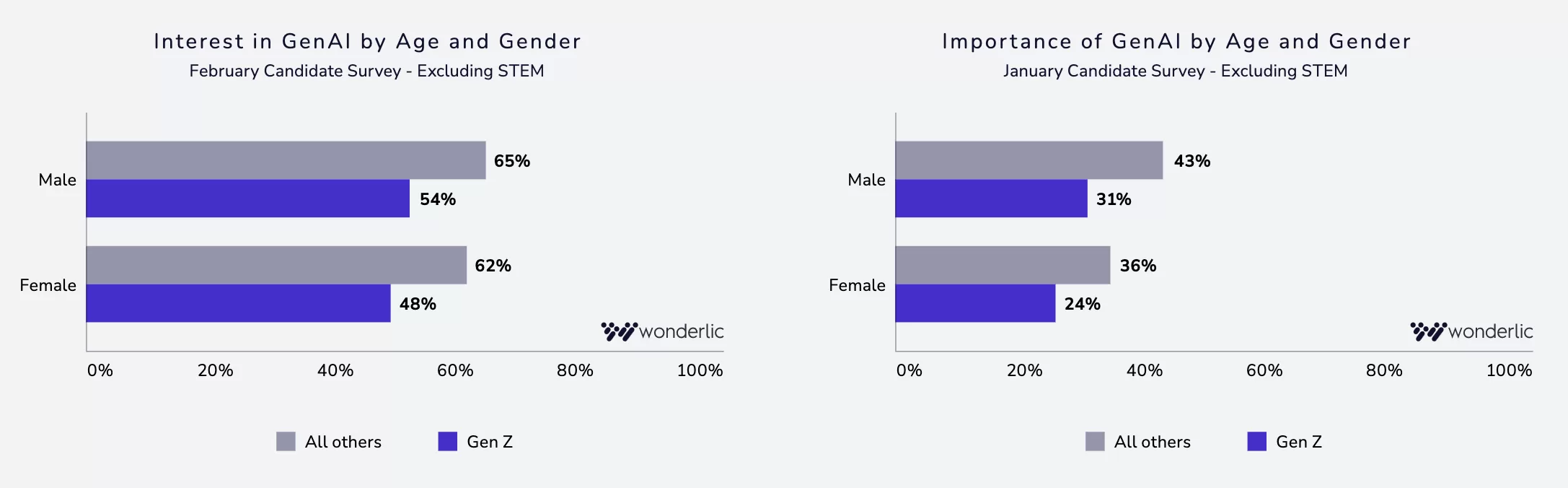
The difference in interest and importance of GenAI at work between Gen Z and all other candidates was consistent for both male and female job candidates. We found larger differences in attitudes based on candidate age (Gen Z versus all other candidates) compared to candidate gender. Male candidates generally were more interested in using GenAI at work or expected that GenAI would be more important in their next job, regardless of age.
What does Gen Z feel about the impact of AI?
More Genz candidaates feel worried, less excited about using generative AI at work
When asked about their feelings towards the impact of generative AI at work, Gen Z candidates were largely more worried or concerned relative to others. Concern among Gen Z candidates was especially high for jobs involving service or hands-on work. However, Gen Z candidates are more excited about AI for jobs where they have shown greater promise such as in STEM or Business-related roles. We explore these age differences in feelings towards AI and outline the various reasons for concern among job candidates in the figures below.
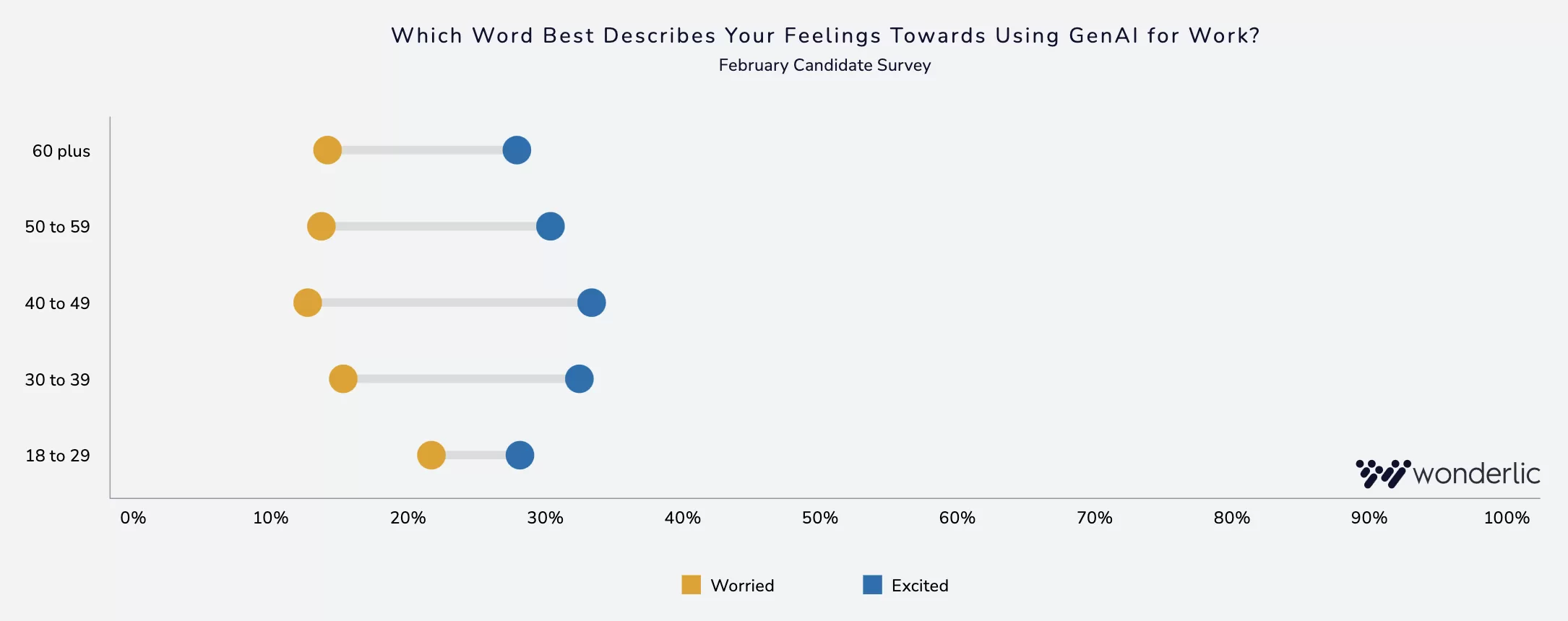
In the February survey, we asked candidates to choose whether they felt Excited, Hopeful, Worried, or Overwhelmed about using GenAI for work. Relative to older candidates, Gen Z candidates (ages 18-29) were more worried (+8) and less excited (-4) about using GenAI for work. Gen Z candidates were slightly more likely to report being excited (28%) than worried (21%) about the impact of GenAI at work. This gap (+7 points for Gen Z) was substantially smaller than the gap between Excited and Worried candidates for all other candidates combined (+18). We observed the highest proportion of candidates excited about GenAI between the ages of 30-39 and 40-49.
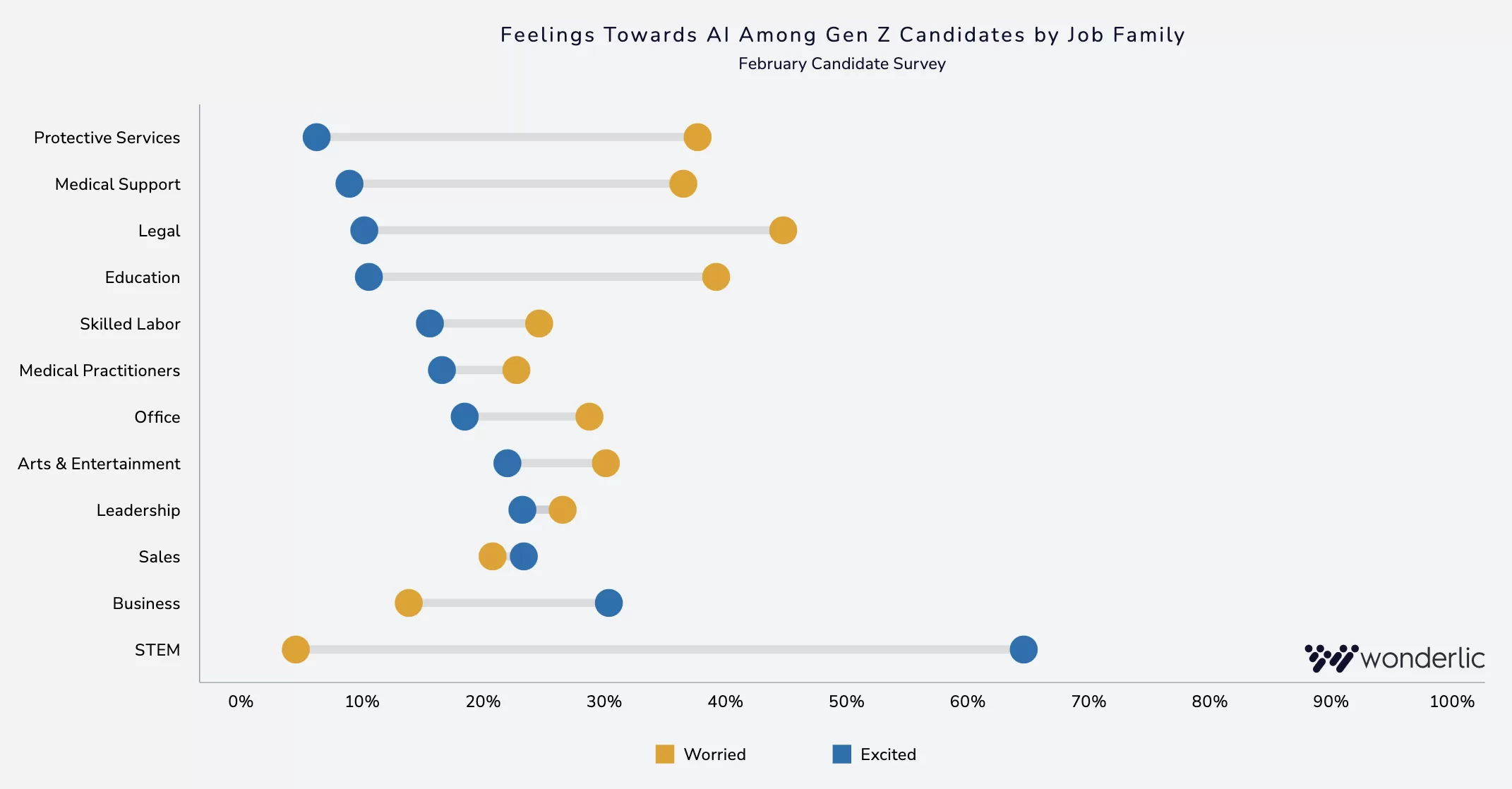
We further explored this gap between excitement and worry among Gen Z candidates separately for each job family. For most jobs, more Gen Z candidates are worried than excited about GenAI. These gaps vary between jobs, and we find the greatest proportion of worried candidates for Legal (45%), Education (39%), Protective Service (37%), and Support jobs (36%). Hiring managers should be aware that candidates for these roles may be discouraged by job postings mentioning AI without clear descriptions of how and why it is a part of the role. The only two jobs where more Gen Z candidates are excited about GenAI are those seeking STEM (65%) or Business/ Finance jobs (31%).
Gen Z is more concerned than every other age group, and AI adopters express less concern except for data privacy.
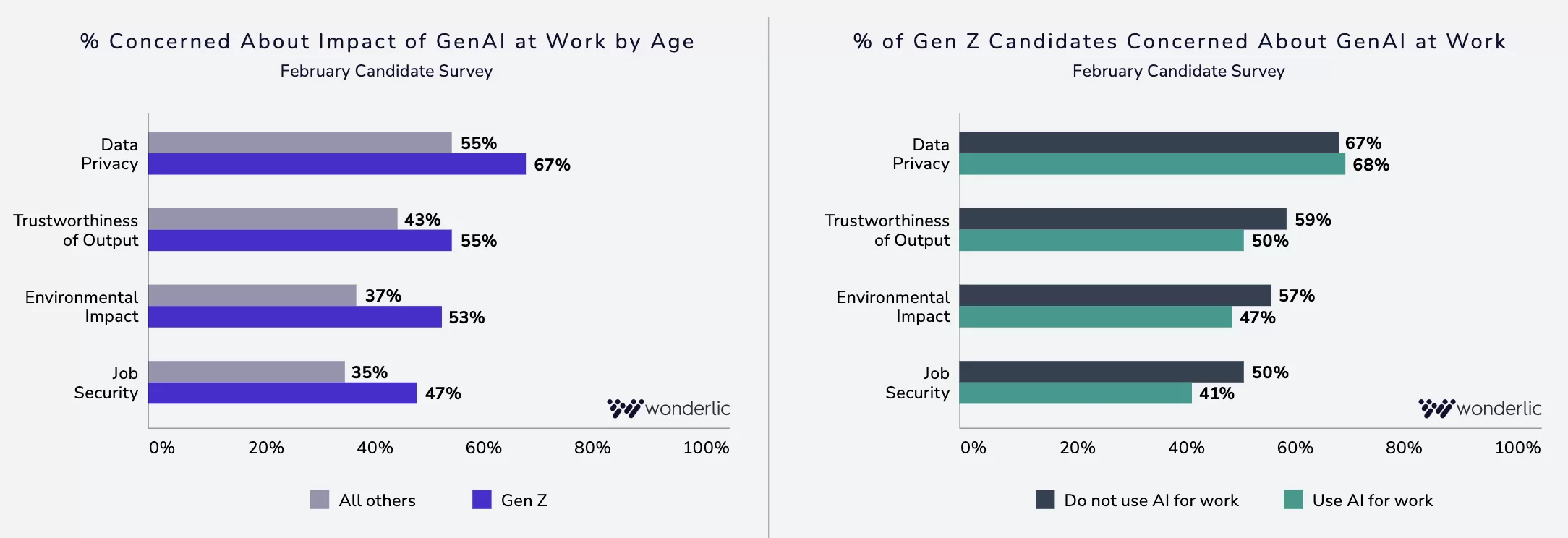
In February, we asked candidates to report their level of concern about different factors or outcomes of generative AI use at work. All candidates rated data privacy as the strongest concern among those that we listed. Gen Z candidates were most concerned about the impact of GenAI on data privacy (67%), trustworthiness of AI output (55%), and the environmental impact of AI (53%). Gen Z candidates were also more concerned about environmental impact (16+) job security compared to older candidates (+12). AI adopters are generally less concerned about the impact of AI compared to those who do not use AI for work. When comparing by AI adoption among Gen Z candidates, those who use AI for work are less worried about impacts on job security (-9) or the environment (-10). In contrast, both groups are equally worried about impacts of AI on data privacy (67% and 68%).
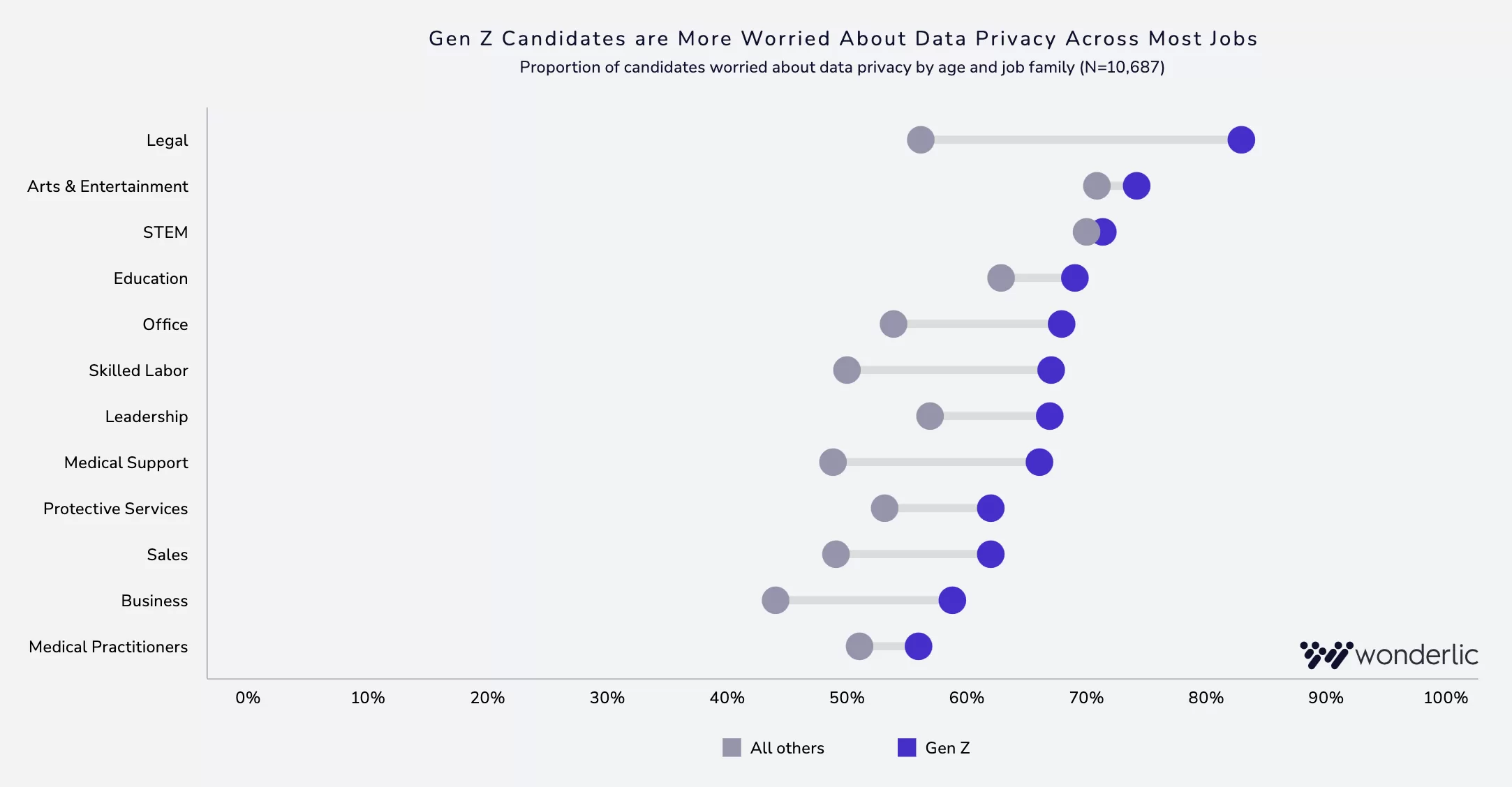
Across almost all job families, more Gen Z candidates are worried about the impact of generative AI on data privacy at work compared to all other candidates. This age gap is especially large for Legal (+27), Medical Support (+17), Business (+15), and Office jobs (+14). For these jobs, younger candidates are likely more sensitive to the potential risks of AI adoption and may want to see formal governance or organizational policies in place to ensure safe use of AI.
How is Gen Z using AI at work or in their job search?
Candidate age has little impact on generative AI adoption or usage
Even though Gen Z candidates are consistently less interested, optimistic, or excited about generative AI in the workplace, these attitudes have not impacted their use of AI at work. Workplace AI adoption has remained stable in 2026 and Gen Z candidates use generative AI for work about as much as older candidates except among those seeking STEM jobs.
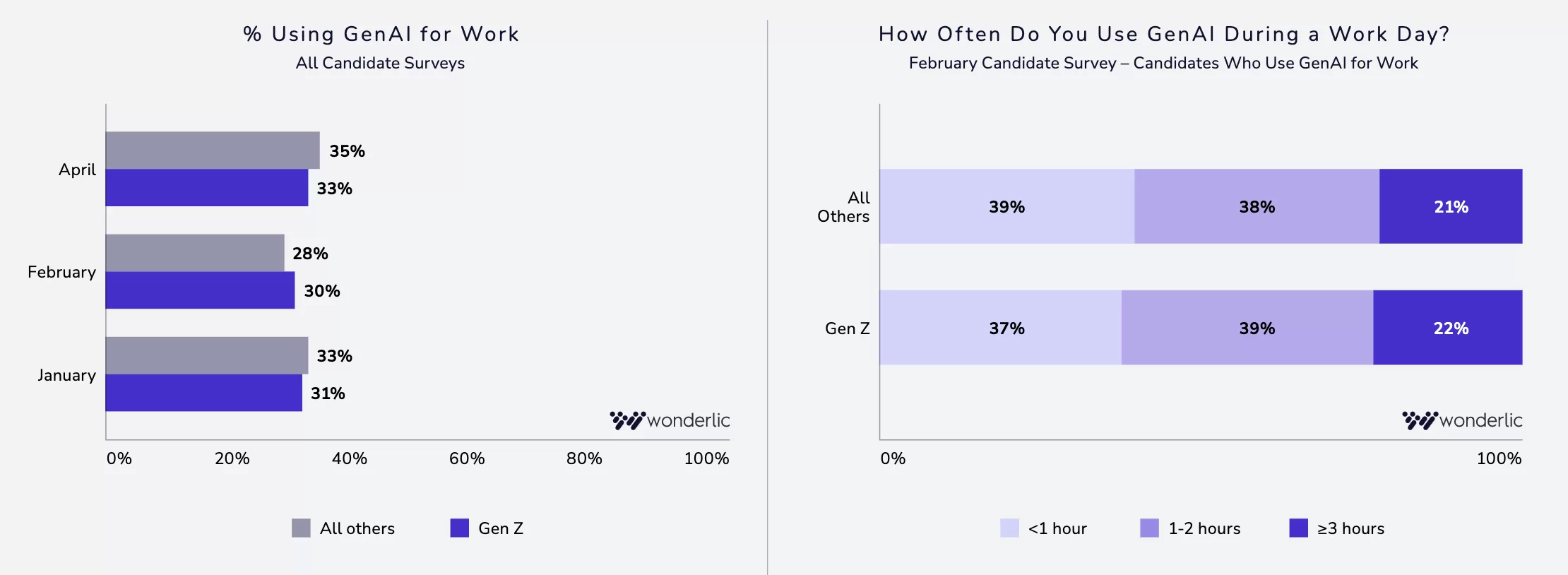
Across all three surveys in Q1 2026, we found very little difference in workplace AI adoption between Gen Z and all other job candidates. In each survey wave, the difference in adoption between age groups was only two percentage points and overall adoption changed little over time. Among GenAI adopters, we also saw practically no difference in the daily time spent using GenAI at work. Most candidates who use GenAI for work typically use it for 2 hours or fewer daily, regardless of age.
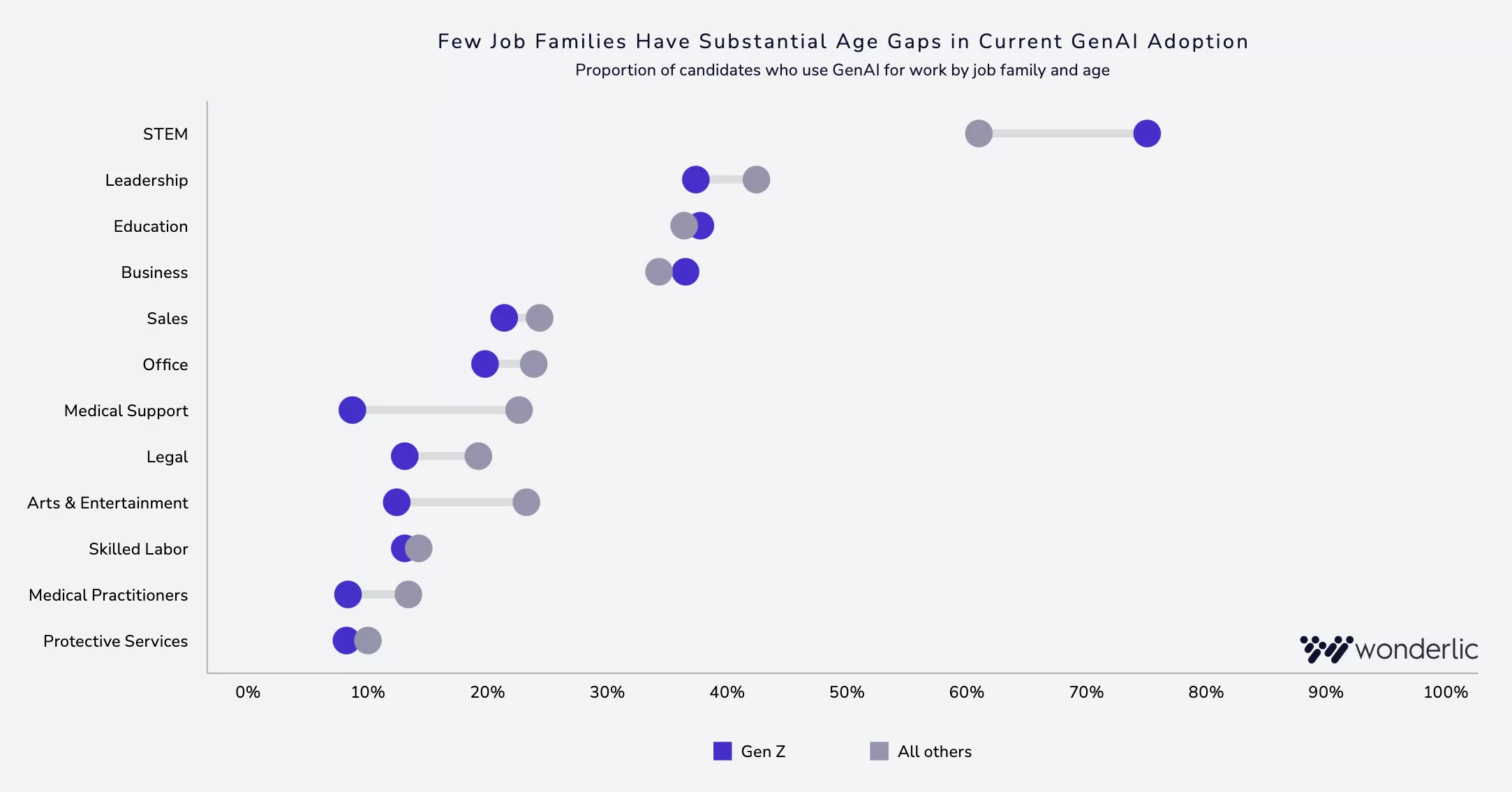
On average, we find little difference in AI adoption between Gen Z job candidates and all others (-2). This overall trend is consistent for most job families where we find that the difference in AI adoption between Gen Z and all other candidates is between only a few percentage points. Of note, Gen Z candidates were more likely to use GenAI for STEM jobs (+14) but less likely for Medical Support (-14), Arts and Entertainment (-11), or Legal jobs (-6). These results indicate that candidate age is a poor proxy for AI readiness. Instead, hiring managers should be careful to focus more on job-relevant AI experience or relevance of AI tools to the demands of the job.
Gen Z candidates are more likely to use AI to learn about companies and prepare for interviews.
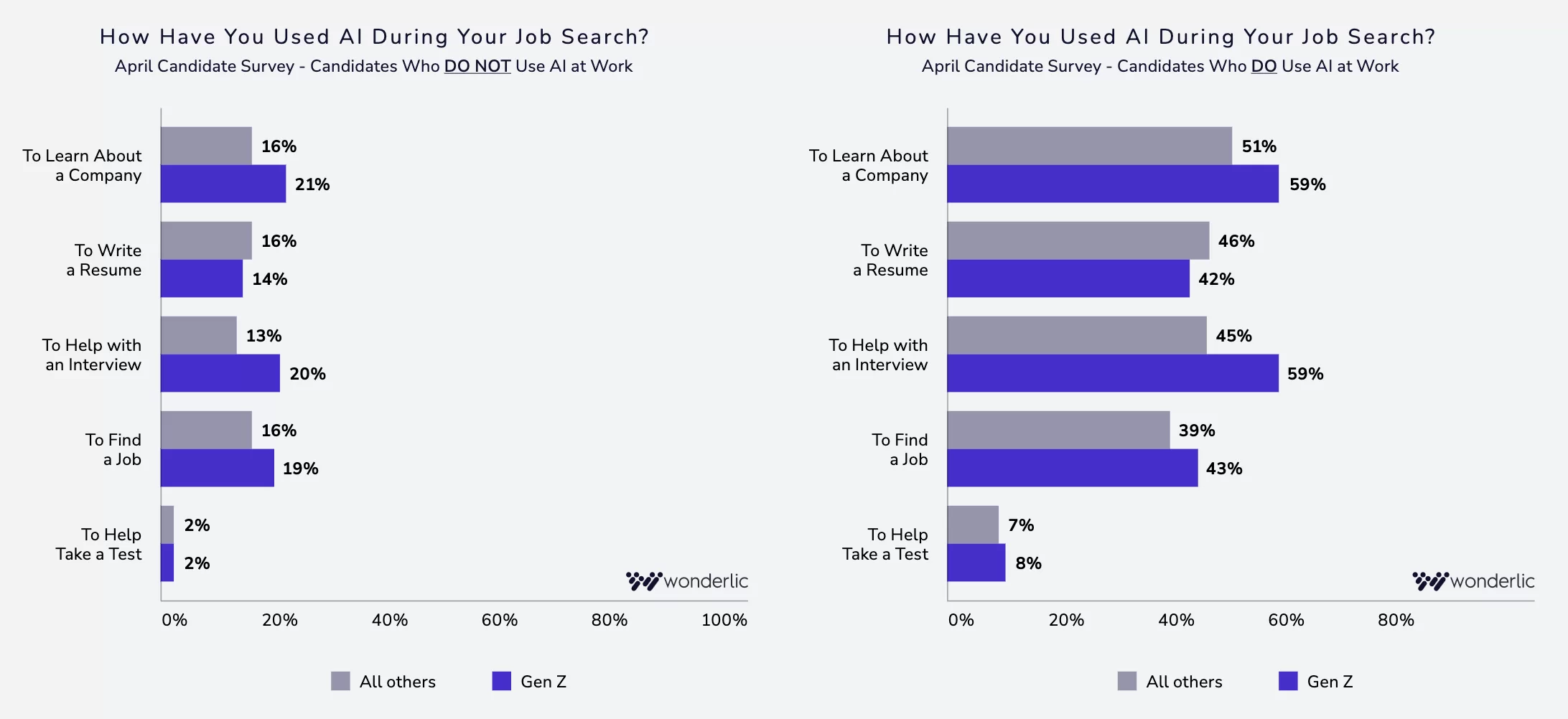
Gen Z candidates are making more use of generative AI during their job searches, especially to learn about companies, writing resumes or cover letters, or to prepare for interviews. These are tasks where candidates can easily use AI tools to get help by generating draft text or searching for information. Despite general negative sentiment among Gen Z candidates, they appear to find AI more helpful for these tasks. Given that AI adopters at work are generally much more likely to use AI in their job search, we examined the data separately based on current AI adoption below.
Conclusions
Although young people are expected to to adopt new technologies, this does not mean that they are always the most excited or enthusiastic. We find that Gen Z job candidates express less interest in working with GenAI, are more concerned about the impact of GenAI, and expect AI to be less important for their next job relative to all other ages combined. We also find very little difference in workplace AI adoption between Gen Z candidates and all others. Gen Z candidates are not more willing to adopt workplace AI and may even be more skeptical about its impact compared to older candidates.
Workplace AI adoption and positive sentiment remain highest among candidates applying for jobs where adoption is highest: STEM or Business and Finance. These fields are where many of the capabilities of generative AI tools are best aligned with daily work tasks. As a result, more candidates have already adopted AI, more are excited about the impact of AI, and more expect them to remain important in the future. Yet, despite high adoption, most STEM candidates are worried about the impact of GenAI on data privacy. This was the only topic where concern was equally high among candidates regardless of AI use at work. Thus, we expect candidates for STEM or Business and Finance jobs will want to see how hiring companies are supporting safe use of generative AI through formal policies, procedures, or processes.
Among the remaining job families, companies may struggle to find Gen Z talent that is seeking to adopt GenAI. We find the lowest rates of GenAI adoption and positive sentiment towards AI use at work among candidates seeking jobs where most time is spent providing care or service to other people or doing hands-on work. Gen Z candidates for these jobs are especially pessimistic about the broader impact of AI at work, as indicated by some of the largest age gaps in AI sentiment or adoption. These results may indicate that the capabilities of generative AI tools appear poorly suited to handle or assist with the primary tasks for these jobs.
Current AI adoption is also the strongest predictor of AI use during various job search activities, including using AI to help prepare for interviews, to learn more about companies, or to help write resumes or cover letters. Gen Z candidates are using GenAI more than others during their job search where they are more likely to rely on AI to help prepare for interviews or to learn about the hiring company. These rates are even higher when looking at Gen Z candidates who already use AI for work. Companies hiring for jobs in STEM or Business / Finance roles may expect candidates to be most amenable to using GenAI for work and expect candidates to use these tools during the hiring process. For other jobs, companies may expect that AI use is less likely to impact their hiring processes due to lower rates of AI adoption among their talent pools.
Methodology
Data in this report were gathered from job candidates in three separate survey waves conducted between January and April 2026. Survey participation was voluntary and no payment or reward was given for survey responses. Only candidates who tested using English language assessment forms were invited to participant in surveys.
All surveys were hosted using a third-party, online survey platform and were self- administered following the completion of Wonderlic Select assessments. Individual survey results are confidential and Wonderlic does not share response data with any individual clients. Job family results are only reported for groups with responses from at least 150 candidates.
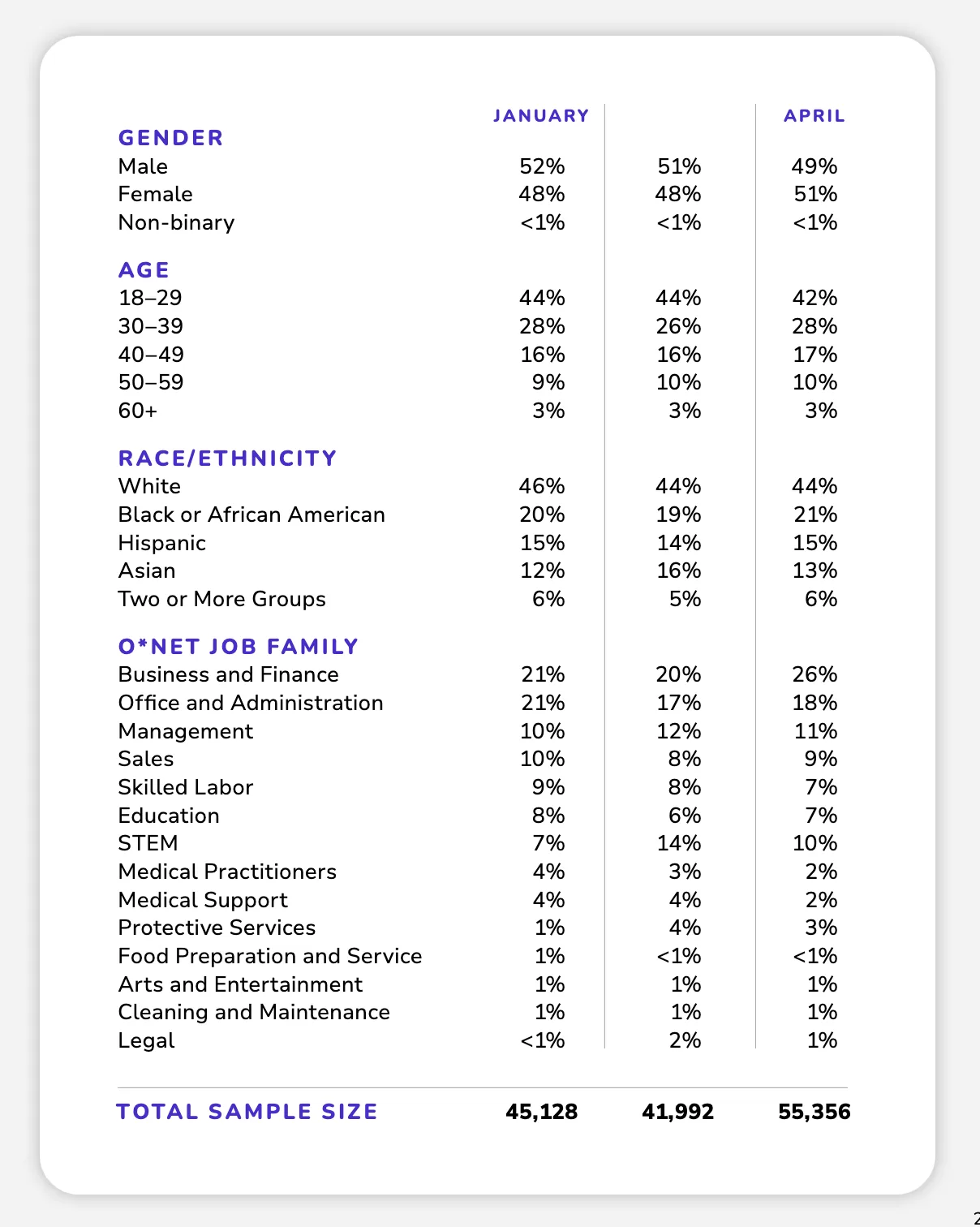
We provide a summary of the demographic and occupational makeup of each survey sample in the following table. Each survey consisted of approximately six questions.
Make better talent decisions with Wonderlic
Wonderlic infuses the latest science directly into your hiring and employee development processes, giving you trusted, data-driven insights to make the right call on talent every time.
Ready to see how Wonderlic can make a difference in your organization?