
Employee Selection

Thinking about using the Enneagram test in hiring? Learn why it's risky, what it misses, and how multi-factor tools like Wonderlic Select improve decisions.
You’ve no doubt come across Enneagram personality tests while surfing the web. You may even use the Enneagram for hiring. But while taking the test can be fun and even revealing, Enneagrams are unlikely to help you hire the ideal candidates. They may even significantly harm your organization if you rely on them for important decisions.
Below, we explore what Enneagram tests are, what they measure, and why they fall short as a pre-employment personality test.
What Is the Enneagram Test and How Does It Work?
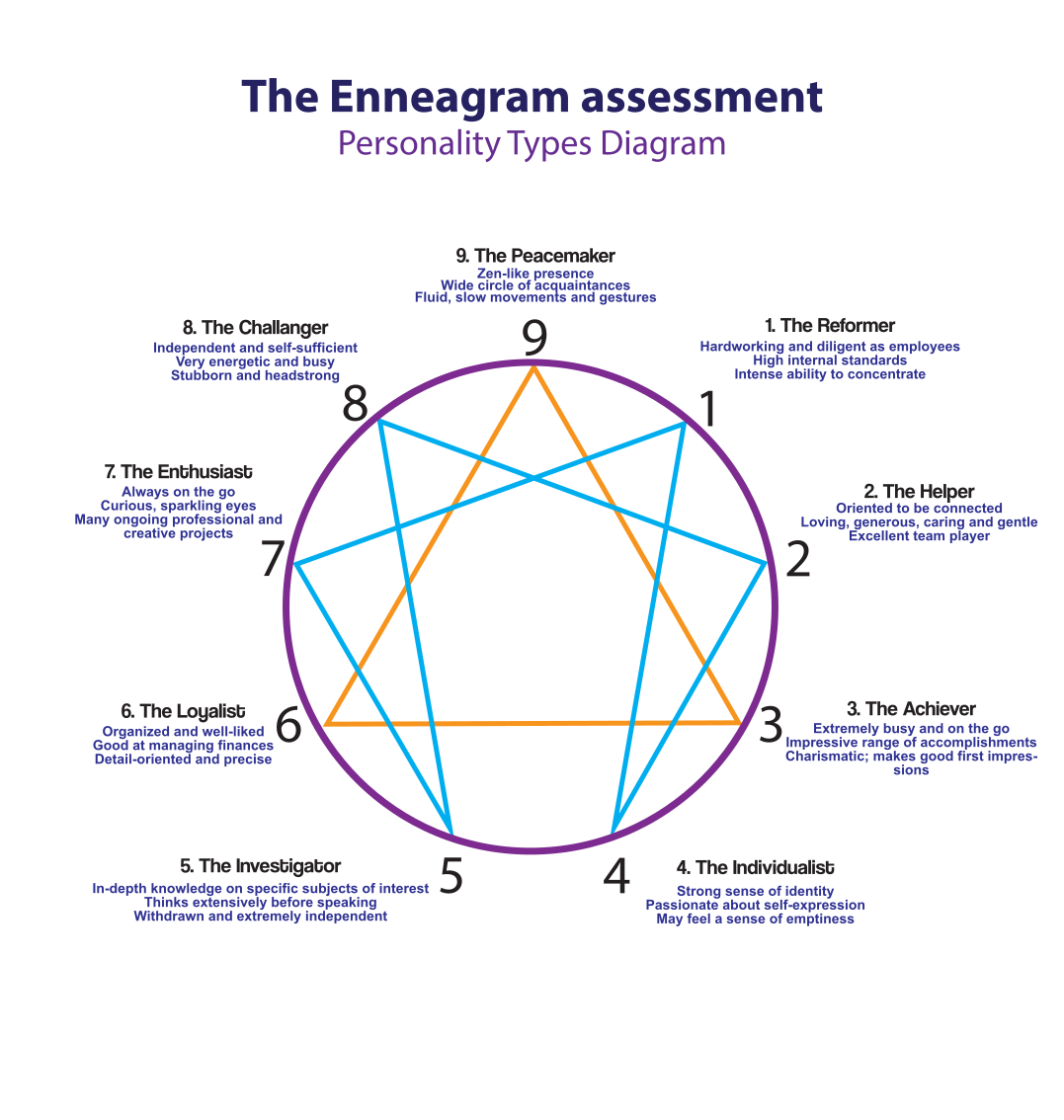
The Enneagram is a framework of nine personality types, often depicted as a geometric figure called an enneagram. It gained prominence in the 1970s and has enjoyed a popularity resurgence during the past few years. Enneagram tests vary in length from just a handful of questions to several hundred.
While the Enneagram can help individuals grow in self-awareness and provide insights into their strengths and weaknesses, many personality assessment experts have dismissed the Enneagram as pseudoscience.
What the Enneagram Personality Test Measures
When taking an Enneagram test, a person is typically asked to rate statements about themselves on a scale from 1 (strongly disagree/inaccurate) to 5 (strongly agree/accurate). The results are said to reveal the test taker’s dominant personality type; each type has its own Enneagram strengths and weaknesses, fears, and desires.
A Quick Overview of the Nine Enneagram Types
Type 1: The Reformer
Sometimes called the Perfectionist, this personality type is idealistic, conscientious, and constantly striving to improve both themselves and those around them, whether those around them want to be improved or not. Lawyer, doctor, and editor are commonly recommended Enneagram type 1 careers.
Type 2: The Helper
More than anything else, this Enneagram type wants to be loved. At their best, Helpers are unselfish and generous; at their worst, they’re overly possessive and people-pleasing. They often gravitate toward teaching, social work, and other careers that make them feel needed.
Type 3: The Achiever
Success is paramount for Achievers. Ambitious, energetic, and status-conscious, they can be inspiring role models but also fall prey to workaholism or become overly competitive. Textbook Enneagram type 3 careers are in sales, finance, and politics.
Type 4: The Individualist
Creative and sensitive, with a tendency toward melancholy, Individualists often feel self-conscious around others, which is why many work as designers, writers, and other types of independent creators. Highly structured and regimented roles, such as lab technician and actuary, are considered Enneagram type 4 careers to avoid.
Type 5: The Investigator
For Investigators, competence and curiosity go hand in hand. Their insightfulness and independence are believed to lead many toward careers as scientists, engineers, and analysts. The downside to this personality type is that they can easily become high-strung, detached, and even obsessed.
Type 6: The Loyalist
A need for security and a desire for guidance drive Loyalists. Generally reliable and eager to promote a culture of cooperation, they can also be indecisive, wary, and anxious. Law enforcement, insurance, and project management are often suggested Enneagram type 6 careers.
Type 7: The Enthusiast
Of all the Enneagram types, Enthusiasts are the most extroverted and impulsive. Their fear of missing out can lead them to become distracted or impatient, but when they’re fulfilled by what they’re doing in a career — one with a great deal of variety, such as journalism, marketing, or PR — they’re focused and infectiously enthusiastic.
Type 8: The Challenger
Enneagram type 8 is sometimes called the Protector, because their core desire is to protect themselves. This manifests in the need to take control of situations. Along with their inherent self-confidence, Challengers can make effective leaders, or they can be overly aggressive and unwilling to compromise or accommodate others. They’re often business owners, managers, and strategists.
Type 9: The Peacemaker
Because peace of mind is a primary goal for this Enneagram type, they’ll work hard to achieve harmony and resolve conflicts. Mental health counselor, HR manager, and mediator are often considered the best jobs for Enneagram 9. Peacemakers do have to make an effort not to become complacent, however, or to simplify problems for the sake of a quiet life.
Why Some Employers Started Using the Enneagram Test for Employees
Enneagram tests are straightforward and the findings easy to understand, which makes them highly attractive to overworked recruiters under pressure to fill jobs fast. This simplicity, however, is actually one reason using the Enneagram for hiring is not a great idea.
Why the Enneagram Test in Hiring Falls Short
J.R.R. Tolkien noted, “Shortcuts make long delays.” Despite how quick and effortless relying on an Enneagram for hiring might seem, doing so can result in a poor job fit and increased turnover for several reasons.
The Enneagram was Not Designed as a Hiring Assessment
The Enneagram test has its roots in philosophy and mysticism rather than psychology and business. It was created to help people better understand themselves, not structured to help recruiters make talent decisions. More importantly, its conclusions are not scientifically validated.
For example, while traits common among Investigators (Enneagram 5s) might make them seem ideal for analytical careers, there is no statistical correlation between that Enneagram type and success in such careers, and Enneagrams of any type can succeed in a variety of different careers.
An Enneagram Test is Not Reliable
Because multiple versions of Enneagram tests exist, results can be inconsistent. Many, if not most, of the questions are highly subjective. Not only might two candidates interpret them differently, but a person might answer them differently each time they take the test, depending on their mood and circumstances. For instance, when asked how they feel about the statement “I believe others will never truly understand me,” a person might respond “Strongly disagree” the day after they get engaged, then “Strongly agree” several weeks later after the engagement is broken.
The Enneagram Types are Too Narrow for Evaluating Candidate Fit
Enneagram tests place people into one of just nine personality categories, or “buckets,” which would suggest there are only nine types of people across the breadth of humanity, and only nine corresponding Enneagram career types: service jobs for Helpers, artistic jobs for Individualists, and so on. However, few people slot neatly into any one personality type. And even if they do, a candidate’s personality traits do not reflect their skills, aptitudes, or experience, and a personality type alone is not highly predictive of job performance.
Risks of Using the Enneagram for Hiring Decisions
As well as being ineffectual, using an Enneagram test in hiring poses certain risks to your organization.
Enneagram-only Hiring can Miss High-potential Candidates
Hard and soft skills, cognitive ability, aptitude to learn, previous experience: These factors and more help all factor into a candidate’s likelihood to succeed. Enneagram interview questions don’t assess any of these factors. In fact, even as a personality test, the Enneagram is lacking, as it doesn’t gauge traits such as sociability or indicate behavioral patterns, such as how a person reacts to feedback and criticism.
Type-based Hiring can Lead to Stereotyping and Bias
Say a candidate’s Enneagram test shows them to be a Loyalist (Enneagram type 6), and you hire them as an office manager for your insurance firm. After several years, they apply for an opening in sales. They clearly know the industry and what the job entails, but you’re convinced only Achievers (3s) make stellar sales professionals. Stereotyping candidates based on the findings of a subjective test means potentially overlooking candidates with strengths and aptitudes that the Enneagram doesn’t account for.
Using Enneagram Personality Tests for Hiring Raises Legal and Ethical Issues
Any test that rules out candidates based on stereotyping or bias leaves an organization open to being sued for discrimination. For example, people raised in cultures that value cooperation over assertiveness might be unlikely to be deemed Achievers (3s) or Challengers (8s), and therefore not considered for sales or leadership positions if recruiters are relying on the Enneagram.
If a disproportionate number of candidates from those cultures are screened out, they could claim disparate impact in hiring, a violation of Title VII of the Civil Rights Act. Candidates could also argue that because Enneagram tests are not scientifically validated predictors of job performance, hiring decisions based on them are arbitrary, just as ruling out someone for a position based on their astrological sign would be.
Beyond the possibility of a lawsuit, relying exclusively on Enneagrams or any other unvalidated pre-employment personality test is an ethical gray area, as it reduces people to stereotypes and reflects organizational or personal bias, for instance, that no Individualist (4) can be a team player, and therefore, none are fit for jobs that rely on teamwork.
What Effective Hiring Assessments Should Measure
Scientifically validated personality assessments are essential in recruitment. Even the best personality tests for hiring alone, however, aren’t enough to accurately forecast a candidate’s likelihood for success.
Looking Beyond Personality to Cognitive Ability and Motivation
Workplace personality assessments help gauge individuals’ general temperament, communication and collaborative styles, and behavioral tendencies in certain situations. These things are important for helping recruiters and hiring managers determine whether applicants will mesh with the organizational culture and how well they’ll complement other team members.
But personality tests don’t assess candidates’ cognitive abilities: their ability to solve complex problems, adapt, reason, and learn. Nor do they accurately gauge candidates’ extrinsic and intrinsic motivations, the things that get them excited and energized, those factors that hint at longevity or burnout.
Multi-measure hiring assessments, which incorporate motivation, personality, and cognitive ability assessments, use the latest industrial-organizational (I/O) psychology and science to provide a more well-rounded, predictive view of candidates, with far more objective data points for improved accuracy. In addition to helping organizations predict how well an individual will perform in a specific role in a workplace, these assessments also suggest how to best manage and nurture an employee for long-term success. They reveal how to best communicate with them, lead them, and help them develop in their careers.
Linking Assessments to Job-related Behaviors and Performance
An Enneagram test for employees won’t indicate how individuals will act in specific job-related scenarios. On the other hand, personality tests designed specifically for the workplace typically ask questions that indicate relevant behavioral patterns. For example, Enneagram type 2 Helpers are said to have a tendency to be overly possessive. Since that’s unlikely to matter for a position as an accountant, why bother testing for it?
Work samples and open-ended interview questions about past actions (“Tell me about a particularly stressful incident at work and how you handled it”) are other assessment tools directly linked to job-related performance.
Building a Structured, Fair Pre-employment Testing Process
A well-structured and fair pre-employment testing process begins by defining the hard skills, soft skills, and traits a person needs to succeed in the job and within the organization. Any pre-hire test you use should assess candidates exclusively for those qualities. Not only does this improve the candidate experience, but it also protects the organization from accusations of arbitrary bias.
The ideal pre-hiring assessment should fit five core criteria: reliability, accuracy, fairness, adaptability, and resistance to candidate self-representation. In other words, it should be difficult for candidates to manipulate the results by giving answers they think the recruiter wants rather than truthful responses. The test also needs to be legally compliant, of course, and the organization should make clear to candidates why they’re being tested and how the results will be used.
Enneagram Test in Hiring vs. Wonderlic Select
Enneagram tests can be great ice-breakers. They can also help employees better understand their strengths and weaknesses or those of their teammates as individuals. But their results aren’t scientifically validated for hiring decisions, the results aren’t specific to the workplace, and the traits they test for are highly limited.
On the other hand, rigorous analysis has proven Wonderlic Select to be scientifically valid and highly predictive of on-the-job performance. Unlike Enneagrams, Wonderlic Select was designed specifically as a pre-employment assessment and is legally compliant. In addition to testing for job-related personality traits, our multi-measure assessment gauges candidates’ cognitive skills and motivations to create a well-rounded, holistic view that’s far more indicative of fit and future performance than a personality test alone.
Rather than screen out “types” of candidates based on a pre-employment personality test, successful HR teams use Wonderlic Select to reliably screen in candidates based on aptitude, skills, and traits relevant to the job they’re applying for.
If you’re currently using the Enneagram for hiring, it’s time to upgrade to a proven tool built specifically to predict candidate fit and future performance.
Ready to upgrade your hiring process? Get a demo of Wonderlic Select today
FAQ About Using the Enneagram for Hiring
Are Enneagram Tests Reliable Enough for Hiring Decisions?
Enneagram tests have not been proven to be reliable for hiring decisions. There is no statistical correlation between Enneagram types and success in certain careers. In addition, because the Enneagram test was not designed as a hiring tool, its findings and interpretations are highly subjective.
Is it Legal or Advisable to Use the Enneagram Test in Hiring?
It is inadvisable to use an Enneagram test for hiring, and organizations that do so are at risk of being sued for discrimination or disparate impact in hiring, a violation of Title VII of the Civil Rights Act. Because Enneagram tests are not scientifically validated predictors of job performance, hiring decisions based on them can be deemed arbitrary and unfair.
What is a Better Alternative to the Enneagram for Hiring?
A scientifically valid multi-measure assessment tool, such as Wonderlic Select, is a better alternative to the Enneagram for hiring. Designed specifically for use in the workplace, Wonderlic Select tests for personality traits and behaviors, cognitive ability, and motivation, providing a holistic view of candidates and how well they fit into the job and the organization.
Related Articles
Employee Development
The Missing Piece in Performance Reviews is Coaching (and How to Incorprate It)

Employee Development
Employee Retention Strategies: 15 Proven Ways to Keep Top Talent and Reduce Turnover

Weekly Insights to Hire Smarter