
Team Dynamics

Many teams use the Enneagram in the workplace, but boxing people into personality types can damage trust and team dynamics. Learn why labels like “only 1s and 3s are go-getters” are harmful and how Wonderlic Team Dynamics offers deeper, work-focused insight.
It usually starts with a workshop. A well-meaning manager invites their team to take the Enneagram for work. Then, when the results come out, there’s a flurry of typing, some laughter, and lighthearted comments like, “Oh my gosh, you’re such a 7!” or “I never knew you were a 4! That explains so much!”
For a while, it’s fun. Insightful, even. But over time, those labels can harm employees and team morale.
In this blog, we explore why using the Enneagram in the workplace can harm team dynamics, and how you can use scientifically backed employee development tools to improve communication, reduce conflict, and build healthier, more productive teams.
Enneagram in the Workplace: The Promise and the Problem
The Enneagram is a framework of nine personality types, often depicted as a geometric figure called an enneagram. The results are said to reveal the test taker’s dominant personality type, with each type having its own Enneagram strengths and weaknesses, fears, and desires.
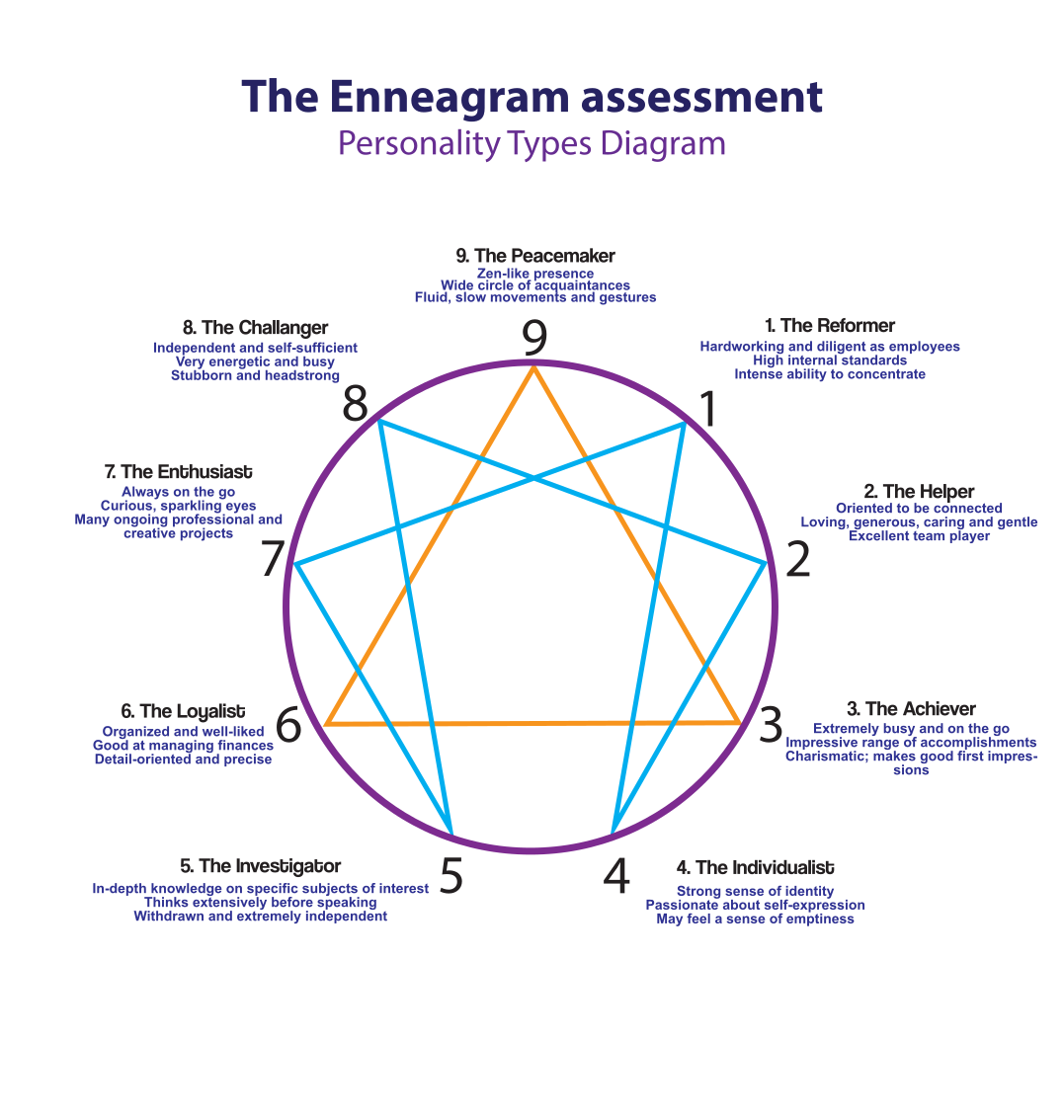
According to the Enneagram Institute, there are nine basic Enneagram types, or personality traits; highlights of each type are as follows:
Type One, The Reformer: principled, purposeful, self-controlled, and perfectionistic.
Type Two, The Helper: generous, demonstrative, people-pleasing, and possessive.
Type Three, The Achiver: adaptable, excelling, driven, and image-conscious.
Type Four, The individualist: expressive, dramatic, self-absorbed, and temperamental.
Type Five, The Investigator: perceptive, innovative, secretive, and isolated.
Type Six, The Loyalist: engaging, responsible, anxious, and suspicious.
Type Seven, The Enthusiast: spontaneous, versatile, distractible, and scattered.
Type Eight, The Challenger: self-confident, decisive, willful, and confrontational.
Type Nine, The Peacemaker: receptive, reassuring, complacent, and resigned.
Why Teams Started Using the Enneagram at Work
The Enneagram has gained a lot of popularity as a personality test in recent years, both in culture and the workplace, very similar to the popularity of MBTI, or Myers-Briggs. It makes sense why teams started using it in the workplace. The tests themselves are usually short and easy, and the results give individuals a framework for understanding themselves.
The Enneagram for work teams creates a common language for discussing everyone’s motivations and personality traits. It even promises to “decode” why teammates act a certain way, adding to its intrigue. But for many reasons we’ll explore below, relying on the Enneagram in the workplace can do more harm than good.
When “Enneagram at Work” Quietly Turns into Labeling People
Problems arise when a personality test meant for self-discovery becomes a way to label and classify employees. The Enneagram personality test has its roots in philosophy and mysticism rather than psychology and business. It was created to help individuals better understand themselves, not structured to help recruiters or managers make talent decisions, help teams function more effectively, or help employees perform better in their roles.
The Danger of Putting Employees into Enneagram Boxes
When people start seeing teammates as an Enneagram number, they can jump to conclusions and even start treating them differently. For example, a manager may decide that an Enneagram 4 (Individualist) isn’t a good fit for a new sales position because of their Enneagram type, or that an 8 (Challenger) is too confrontational to succeed in a customer success role.
“We Only Want 1s and 3s” and Other Harmful Shortcuts
Another example includes recruiters or managers deciding they only want “go-getters”, the 1s and 3s, for high-impact roles, while relegating 5s to back-office roles and deeming 9s as too lazy for their team.
Then, there’s the problem of self-fulfilling prophecies. If someone is told they’re a certain personality type, they may start unconsciously acting that way, even if it’s to their detriment, even if it’s not intentional.
Good Employees are Found in All Nine Types
The truth is that great employees, across careers, are found in all nine types, and high-performing teams benefit from a wide breadth of personality types, skills, and experiences. In fact, research proves the advantage of diverse teams, revealing that:
- Inclusive teams make better business decisions up to 87% of the time
- Teams with inclusive processes make decisions 2x faster with half the meetings
- Decisions made and executed by diverse teams deliver 60% better results
While using the Enneagram in business teams may seem harmless at first glance, making important talent decisions based on its results or trying to determine someone’s leadership or work styles, can quickly become discriminatory while undermining inclusion and diversity. Teams need diversity to avoid groupthink and tackle complex problems from multiple angles.
Hustle Culture, Stigma, and Privacy Concerns at Work
Finally, there’s the issue of privacy. Some employees may not want their teammates to know their Enneagram numbers. Many employees don’t want to be seen as their “type.” If a 9 doesn’t want their number shared in a high-performance workplace culture, for example, or a 4 fears judgment from their peers for their individualistic nature, forcing them to disclose their types can eat away at their psychological safety, an essential requirement for high-performing teams.
Consider that Google’s Project Aristotle, an initiative meant to unearth the makeup of effective teams, found that teams with strong psychological safety had 19% higher productivity and 31% more innovation than those with low psychological safety. In addition, they made fewer errors and were far less likely to lose team members. Employees shouldn’t feel pressured to share personal information they don’t want to, or worry that their Enneagram type will affect their professional opportunities.
Why the Enneagram Alone Isn’t Enough for Team Development
The constantly evolving nature of work is a cliché, but it also proves why the Enneagram test for work isn’t effective for team development. Teams form and reform. New skills, like AI, are constantly sprouting up, requiring employees to grow and adapt. And an employee’s responsibilities are constantly in flux.
Modern work is fluid. Just consider that 71% of employees today perform work outside the scope of their job descriptions. Enneagrams provide static results. Someone is a certain type, and that’s all there is to it. There isn’t room for dynamic, changing external circumstances or workplace-specific nuance, which organizations need for effective team and employee development solutions and team building and training.
The Enneagram Doesn’t Measure How People Actually Work Together
In addition, the Enneagram explores core desires and fears that, when looked at together, can predict behavioral patterns. But the Enneagram doesn’t assess individual work styles in a team, how individuals communicate or make decisions, or where conflict may arise.
One-off Enneagram Workshops Rarely Lead to Lasting Behavior Change
When used thoughtfully and carefully, the Enneagram for work teams can be a fun team-building activity. But it doesn’t often lead to long-lasting results that translate to improved team performance. That’s because the Ennegram isn’t designed for the workplace or for team building: it doesn’t provide actionable strategies for improving communication with team members.
Without a clear, scientifically validated path for development and actionable next steps, teams that rely on the Enneagram for team training and team building will find it a fun activity and not much more. To build a high-performing team, you need real-time, scientifically validated insights into how individuals communicate, how they’re best led, and how to help them become more effective in their roles, as individuals and a unit.
You Can’t Build Great Teams by Cloning One “Ideal” Type
Like-minded Teams Aren’t Always High-performing Teams
While it might seem strategic to build a team of solely highly ambitious types, like 1s and 3s, homogenous teams rarely produce the desired results. Worse, they become vulnerable to blind spots and groupthink, the latter of which occurs when team members are so eager for cohesiveness or anxious to avoid conflict that they choose the least objectionable resolution to a problem. They agree with the decisions of others without considering whether those are the best choices.
Diverse Thinking and Communication Styles are an Advantage
People with different experiences and backgrounds approach problems from different angles. They can suss out blind spots and offer strategic alternatives to the status quo. That’s why high-performing teams combine multiple personality types from a wide variety of backgrounds, pairing ambitious individuals with skeptics, decision-makers with analysts, and so on. There is no single best personality type. In fact, having too much of one personality can become a hindrance.
A 2024 meta-analysis of 500+ teams found personality traits explained less than 10% of the variance in team performance. More than just a personality test is needed to understand individuals and build a productive team. Improving team dynamics starts with looking at the team as a unique entity and working with the individuals to improve communication, remove friction, and accomplish meaningful work.
Team Dynamics Depends on Interactions, not just Individual Types
A team isn’t the sum of its personalities, just like individuals aren’t their personality types. People bring experiences, skills, and unique thoughts that make them individuals. And every team is uniquely comprised of individuals, making each team one of a kind.
There are pros and cons to this reality. Certain people will inevitably clash with others. Others will thrive. The same Enneagram type might thrive in one team and fail in another. Improving team dynamics requires a grounded understanding of how to improve communication, smooth out friction, and bolster complementary strengths, regardless of the personality types present.
What Effective Team Dynamics Tools Should Actually Deliver
When trying to gauge someone’s workplace behavior, rather than asking what Enneagram number they are, which reduces them to a label, try asking open-ended, work-specific questions, such as “How do you handle and communicate under pressure?” or “What energizes you and drains your energy at work?” These kinds of questions help you gain more nuanced insights into how a person might fit into your team.
Clarity on Collaboration, Communication, and Decision-making Styles
Team dynamics are shaped by how multiple people act, both individually and as a unit. Understanding and improving those team dynamics requires a scientifically backed team dynamics assessment, which reveals how team members communicate and make decisions.
Scientifically-backed insights from tools like Wonderlic Team Dynamics can give your team a common language backed by leading industrial-organizational psychology to improve interpersonal interactions in your team, helping you strengthen collaboration and problem-solving, reduce conflict, and align individual strengths with team goals.
Practical Coaching Guidance Managers can use in 1:1s and Team Meetings
When thinking about the Enneagram and leadership, if you want to put scientifically backed insights to work as a manager, you should start thinking like a coach, someone who guides and supports team members, who gives them meaningful feedback tied to their development. Just consider a survey from Pew Research that found that 84% of workers who regularly got feedback from their managers were extremely or very satisfied with that relationship.
When you meet with your team members, ask what’s in their way and how you can help them. Define clear outcomes for their role, and make sure to follow up with any promises. You can use insights from tools like Wonderlic Team Dynamics in these situations to guide these conversations, better understanding their least effort and highest effort attributes, in other words, what comes easily to them, and what doesn’t, and where they have room to grow. When employees know you’re in their corner and you’re helping them achieve their goals, their performance will jump, and they’ll be far more likely to stay with your organization.
Enneagram in the Workplace vs Wonderlic Team Dynamics
The Enneagram Offers a Single Lens on Personality
At its best, the Enneagram test sparks greater self-awareness. But it lacks scientific rigor, and its results can be easily misapplied, especially when reducing employees to labels. Its results aren’t designed for workplace settings, after all, and it doesn’t reveal how to help teams build healthier dynamics.
Wonderlic Team Dynamics Provides a Multi-dimensional View of your Team
Wonderlic Team Dynamics, on the other hand, is purpose-built for team development. An extension of Wonderlic Develop, Team Dynamics gives employees scientifically-backed insights into their aptitudes and challenges relative to their role. It shows them how they communicate and work best, alone or with teammates, and where gaps exist, all while providing actionable steps to improve their collaboration, communication, and performance and grow in their careers.
Wonderlic Team Dynamics helps you understand:
- How individuals prefer to communicate
- How they collaborate and handle conflict
- Where friction and blind spots are likely to appear
Likewise, Team Dynamics gives managers insights into how team members act based on multiple dimensions, not just personality, revealing how to best lead individuals and foster constructive, healthy team dynamics.
From “Who are the 3s and 8s?” to “How can We Help this Team Work Better Together?”
Remember, every team is different. Because the individuals who comprise it are just that. Individuals. A team isn’t any better or worse due to its inclusion of 1s or 9s. Improving team dynamics starts with looking at the team as a unique entity and using scientifically backed insights that use cognitive, motivation, and individual and team personality assessments to help individuals improve communication, reduce friction, and accomplish meaningful work.
How to Use the Enneagram Responsibly If Your Team Already Loves It
All said, you may still want to use the Enneagram for team building and improving communication at work, as a fun, lighthearted exercise. If so, here are some tips to make sure it’s a positive experience.
Keep Enneagram Voluntary and Low Stakes
Make participation optional. Understand that not everyone will want to disclose their type. They also may not want the Enneagram used to explain their behavior, so avoid publishing the results for everyone to see.
One way you can accomplish this is by having an informal session that teaches about the Enneagram. The session can explain how it works and give an overview of the nine types. Then, at the end, you can give people the option to share their type, only if they’d like. This way, people who find it helpful can walk away with greater self-awareness without needing to divulge anything they don’t want to.
Never use Enneagram Types for Hiring, Promotion, or Performance Labels
Next, never consult the Enneagram for important talent decisions. It’s not validated for hiring, assessment, or development, and using it to filter out applications or employees can introduce serious legal risk.
Remember, any test that rules out candidates based on stereotyping or bias leaves an organization open to being sued for discrimination. For example, consider how biased a statement like “We don’t hire 9s” is.
Let Wonderlic Develop be the Foundation for Serious Team Decisions
Think of the Enneagram as seasoning for an intentional, well-thought-out employee development program. If your team uses the Enneagram informally or finds it useful in passing, that’s fine. Just make sure you’re using scientifically backed tools like Wonderlic Develop and Wonderlic Select for important talent decisions.
Build a High-Performing Team with Wonderlic Team Dynamics
It’s tempting to use popular personality tests to predict people’s effectiveness in a role. However, labels can mislead far more often than they help. High-performing teams are made up of individuals with all types of personalities, experiences, and skills. Leading them as a cohesive unit requires viewing your team as a whole and using the right tools, backed by leading industrial-organizational psychology, to improve communication, foster collaboration, and reduce friction.
If you’re currently leaning on the Enneagram to make hiring or management decisions, it’s time to upgrade to a tool built specifically for businesses.
Ready to build a high-performing team? Request a demo of Wonderlic Team Dynamics today.
Related Articles



Weekly Insights to Hire Smarter