
AI at Work: What 45,000 Job Candidates Actually Tell Us
 |
April 22, 2026
|
April 22, 2026


Test Takers
 |
April 22, 2026
|
April 22, 2026

New data from 45,000+ job candidates reveals that despite 70% having used generative AI, workplace adoption remains slow and most workers don't expect it to change anytime soon. Discover what the numbers say about where GenAI is actually making an impact.
Most of what we know about how GenAI is changing work comes from anecdotes of GenAI use and optimism among prominent executive leaders. However, the attention and investment in GenAI has not resulted in demonstrable increases in workplace productivity or profitability for most organizations. We surveyed over 45,000 job candidates to address this divide and to understand how GenAI is being used within the broader job market.

CEO
Becca Callahan
Our results indicate that GenAI use has changed little over the past year:
We surveyed over 45,000 job candidates in Wonderlic Select between December 2025 and January 2026.
Candidates answered a short series of questions about their experiences using Generative AI (GenAI) at work. We defined GenAI for candidates as a type of artificial intelligence that creates text, images, audio, or video in response to prompts (for example, ChatGPT and Gemini). This sample spans nearly all 13 job families as classified by the U.S. Department of Labor and provides a diverse range of perspectives on the relevance of GenAI in the workforce. We highlight several key findings from the survey in the following sections.
Most job candidates do not consider GenAI to be an important part of their current or future jobs.
Workplace use of GenAI is greatest among STEM job candidates who report using GenAI for the largest variety of tasks and more often during the work week. Half of all Leadership candidates are using GenAI, but mostly for information tasks. Most other candidates, however, do not see GenAI as an important part of either their current or next job. These results indicate that GenAI has yet to find widespread application at work despite the competitive pressure on organizations to make greater use of GenAI. Workplace adoption is likely to remain low until organizations identify how GenAI capabilities can meet the demands of jobs beyond STEM fields or leadership roles.
GenAI use has doubled among working adults, but workplace adoption is slow.
Roughly 70% of job candidates report having used some form of GenAI but only 32% of report using GenAI for their current job. These results indicate a dramatic increase in general use of GenAI (twofold increase compared to results from a 2024 NBER survey). Despite these gains, GenAI use at work has only increased four percentage points (from 28% to 32%).

Candidates who use GenAI at work expect that it will be more important in their next job.
Among candidates who do not use GenAI in their current job, few expect that GenAI will be important in their next job. When looking at individual jobs, the proportion of candidates currently using GenAI at work is strongly correlated with perceived importance of GenAI among candidates (r = .90).

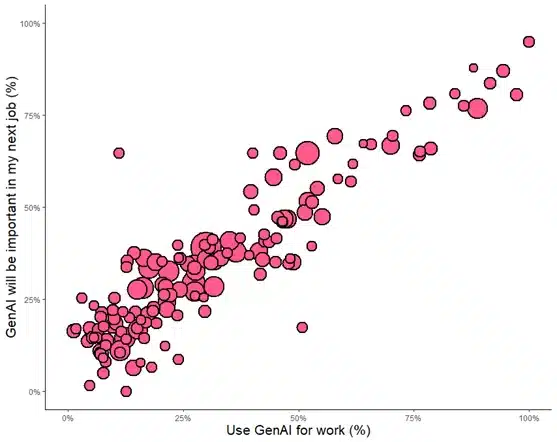
Note. Each data point represents an individual job with 50 candidates or greater. Point size indicates the number of job candidates (larger = more candidates).
GenAI use is most common among candidates for STEM and Leadership jobs
Candidates for STEM or leadership jobs were most likely to report having used GenAI (+70%) and to currently use GenAI at work (+40%). In contrast, less than half of candidates for Sales or Office and Administrative jobs report using GenAI at work (< 30%) despite most having used GenAI in general (+60%). Candidates for skilled labor jobs were among the least likely to have either used GenAI (40%) or to use it for work (17%).

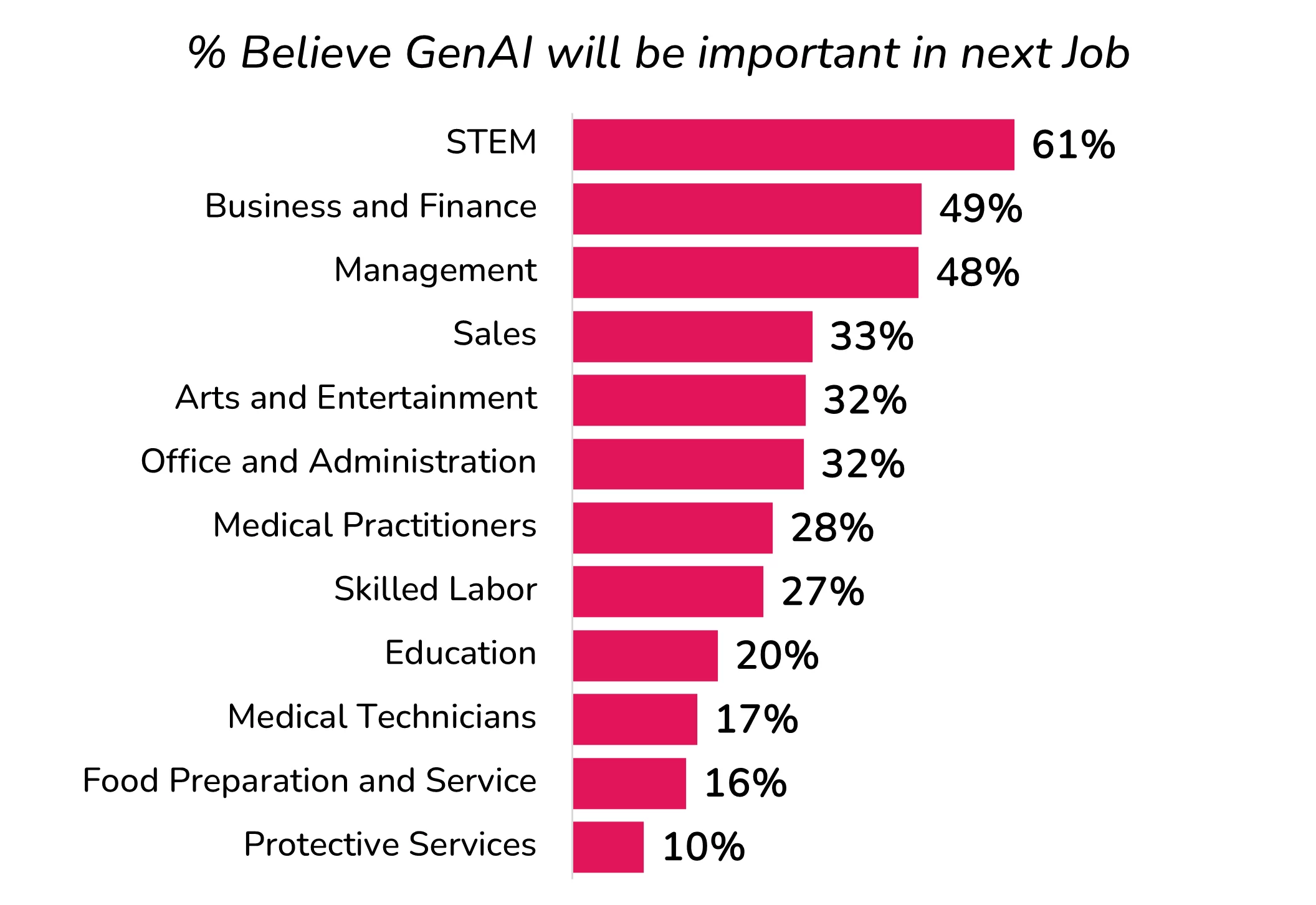
Nearly Twice as many candidates expect GenAI is important for STEM Jobs as compared to Sales and other Office or Administrative Jobs.
According to job candidates, GenAI is most important for STEM, Business and Finance, and Management jobs. Over half of STEM job candidates expect GenAI to be important in their next job (+58%). GenAI is considered more important among candidates for Business and Finance or Management jobs (48%) compared to candidates for Sales (33%) or Office jobs (32%).
GenAI Use is greatest among STEM and Leadership job candidates (+50%).
Over half of job candidates for the following job titles reported using GenAI in their current job. These candidates are also the most frequent users of GenAI at work and most expect that GenAI to be important in next job.

GenAI use is lowest for Skilled Labor or Service Jobs candidates (< 12%).
We observed very few candidates for these jobs who report using GenAI in their current jobs (11% or fewer) or expect GenAI use to be important in their next job. Most candidates (+80%) report not using GenAI at all during the last work week.

Candidates are using GenAI at work for simple information tasks or to help with communication.
Among candidates who already use GenAI at work, most use it for basic tasks like searching, summarizing, or organizing existing information. Few candidates use GenAI for more advanced tasks like automating data analysis, coding, or administrative tasks.

STEM candidates are most likely to use GenAI for data analysis or to generate ideas.

Note. All percentages are taken among candidates who currently use GenAI at work.
Drawing from one of the largest survey samples to data on GenAI workplace adoption (responses from over 45,000 job candidates), we find that GenAI has yet to become an important tool for everyday work. Despite the volume of media attention and financial investment into GenAI technology, increases in workplace adoption have lagged year-over-year. We project that this lag indicates uncertainty around how GenAI can be used for specific, meaningful job tasks. Instead, GenAI is mostly used as an easy way to search for information or assist with written communication even among the earliest adopters. We do not expect to find any dramatic surges in workplace adoption without more job-specific use cases for GenAI.
This study is the first in a series of candidate surveys that Wonderlic will be administering throughout 2026 to discover the ways in which GenAI is impacting prospective employees. We will continue to track trends in job-specific GenAI adoption as well as investigate how candidates are using GenAI during their job search and perceived barriers to adopting GenAI. In addition to this work, future Talent Intelligence Quarterly reports will explore trends and research findings in talent assessment and development as informed by data gathered from our clients and candidates.
A total of 45,128 job candidates completed our AI at work survey between December 12, 2025 and January 26, 2026. Most candidates identified as Male (52%), as White (46%), and were aged between 18 and 29 years (44%). We provide a full summary of our survey sample in the table below.